


.png)
20 Trade Fair Tips for Handmade Brands (And 3 Things You Might Underestimate)

Updated: May 11
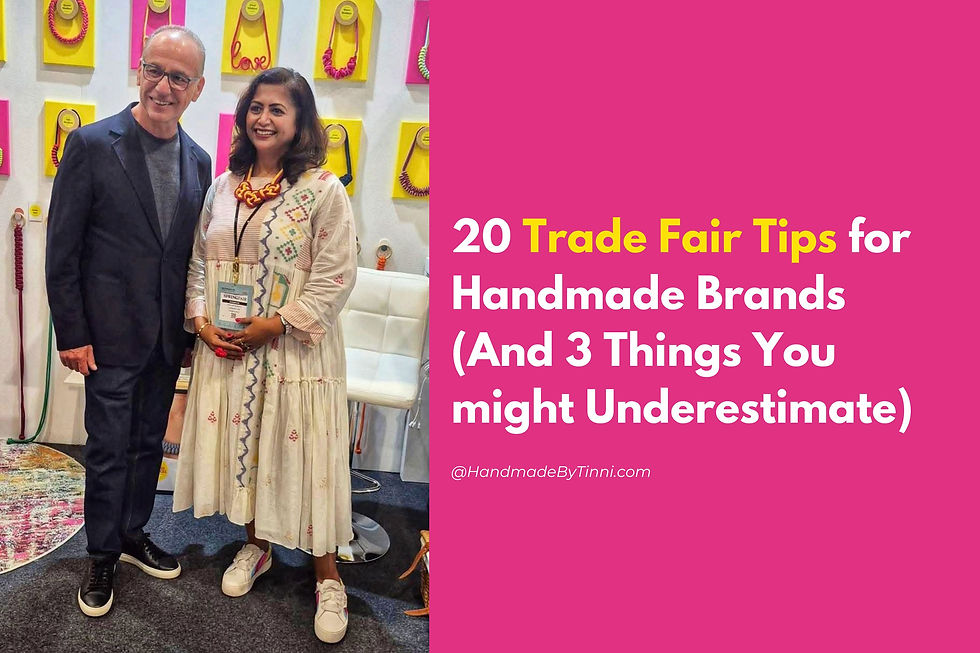
A real, first-time experience from exhibiting at Spring Fair — what worked, what didn’t, and what I’d never forget again.
If you’re a handmade brand thinking about exhibiting at a trade fair, it can feel like a big step — and not always in the exciting way.
It’s easy to imagine it as just setting up a stand and showcasing your products. In reality, it’s a mix of investment, planning, energy, and a surprising amount of observing how people actually behave in real time.
I’ve exhibited at Spring Fair with Handmade by Tinni — a colourful, slightly chaotic-in-a-good-way jewellery brand — and this guide comes directly from that experience. Not strategy. Not theory. Just what actually happened when I was in it.
Some things worked beautifully. Some things I only understood afterwards. And a few things I would never do again.
Want the quick version?
I’ve turned this into a downloadable one-page guide you can save or print for your next fair.

How I even got there!
This wasn’t a random booking.
My journey:
Won SBS (Small Business Sunday) in 2022 and I was incredibly proud to receive my certificate from Theo Paphitis himself.
Applied for SBS x Spring Fair opportunity in 2025
Selected as 1 of 12 lucky winners
Got a fully funded stand at Spring Fair — one of the UK’s biggest retail trade shows
And suddenly… I was exhibiting at one of the UK’s biggest trade shows.
If you’re early in your journey — this path is genuinely worth exploring.
Before You Exhibit
1. Go to a trade fair before you even think about exhibiting -
This was honestly the most useful thing I did. I visited not to “research properly” or take notes like a strategist — just to walk it like a buyer.
You start noticing things quite instinctively:
where you slow down without thinking
what you completely walk past
which stands feel effortless to be in
And it’s rarely about size or budget. It’s just feeling.
That feeling is what you’re trying to recreate later.
2. You probably don’t need more props -
I didn’t go out and buy loads of new display pieces.
Most of what I used, I already had — frames, boards, boxes, bits collected over time.
But I was quite strict about one thing: everything had to feel like it belonged in the same world.
Same colours. Same mood. Same language.
Nothing added just because there was empty space.
That’s usually the difference between “curated” and “a bit of everything”.
3. You don’t need a big budget (but you do need consistency) -
At a fair like this, consistency is everything.
It’s very easy to dilute your brand when you’re trying to make a stand feel “full enough”.
I kept coming back to a simple question:does this actually belong in my world — or is it just filling space?
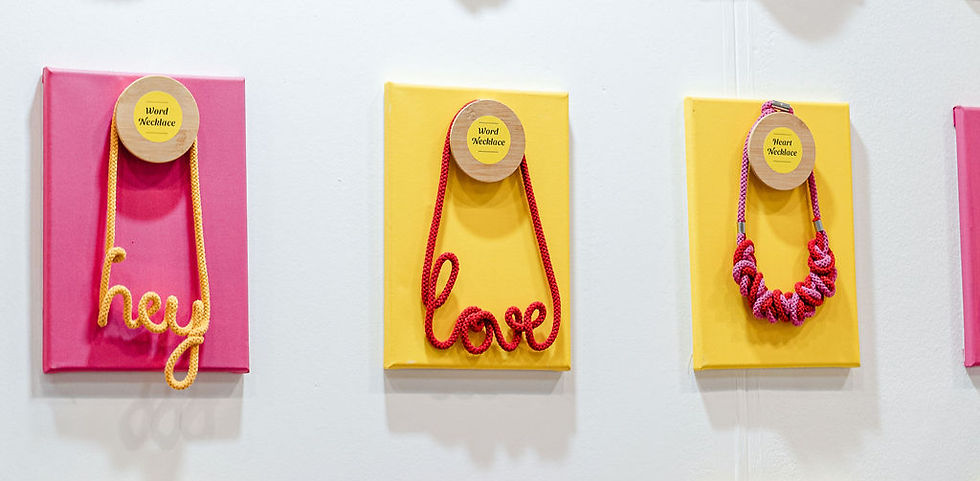
My boards were planned around my brand colours.
Not random. Not mixed. Intentional. Colour consistency makes a stand recognisable from afar. Your colours are your identity — use them boldly.
When everything aligns visually, people spot you from a distance.
More importantly, they remember you afterwards.
(For prints, I used Vistaprint — not sponsored, just what worked for me.)
4. Make it easy for people to find you -
One small thing that makes a big difference: add your hall and stand number to your bio about a week before the show.
At large fairs like Spring Fair, people aren’t searching in a calm, methodical way — they’re scanning quickly, often on their phones while walking the halls.
If someone’s already heard of you or wants to find you again, This removes friction instantly — especially for buyers and press trying to find you quickly.
It’s a tiny update, but it makes you far more discoverable — to buyers, press, and even other exhibitors trying to track you down.
5.Treat the fair like live market research -
Yes, you’re there to sell.
But you’re also surrounded by your entire industry in one room — which is quite rare.
If you listen (without overthinking it), you start picking up things like:
what price points feel natural in the space
what people keep returning to
what gets picked up, held, then put back
Even the casual conversations next door tell you more than you expect.
You come away with a much clearer sense of where you sit.
Stand Design & Buyer Behaviour

6. Put your best pieces where people naturally look -
Buyers don’t scan — they decide fast. This one changed everything for me.
Buyers:
look straight ahead first
decide in seconds
either walk in… or walk past
Your bestsellers belong at eye level. Not hidden. Not low. That one shift can increase orders instantly.
7. Your stand is a visibility moment — use it properly -
Trade fairs aren’t just about buyers.
They’re also about:
who visits you
who shares your work
who remembers you later
Invite voices aligned with your brand. Creators. Retail experts. Communities.
Warm visits create authentic exposure — and lasting relationships.
I was so lucky to connect with these industry leaders that I have always admired from far. Thank you for taking the time out from your busy schedule at the fair and for visiting my stand.
Ami Rabheru, former Retail Buyer and founder of Retail Huddle @retailhuddle
Catherine Erdly, Founder - The Resilient Retail Club, @resilientretailclub
Therese Oertenblad - Small Business Collaborative (Wholesale Guru), @small_business_collaborative
Hannah Bartlett @jollyfestive
The Christmas Insider 🎄 | Founder & Editor of Jolly Festive 🎅 | Christmas Writer, Creator and Festive Trend Researcher
Fay Tranter, Event Director, Spring Fair, @springautumnfair
Those visits?They don’t just give exposure — they build long-term relationships.
8. Giving people something to do changes everything -
I added a small rope-knotting play element to my stand.
Nothing complicated — just something tactile. And it completely changed the energy.
People stayed longer. They relaxed. They talked more.
It turned the stand from something you look at into something you step into.
9. Make it very easy to understand your brand -
At a trade fair, attention is short.
Someone should be able to glance at your stand and immediately get:
what you make
roughly where you sit
what makes you different
If they have to figure it out, they usually won’t.
Not because they’re not interested
— just because there’s too much happening around them.
I kept my stand:
open
uncluttered
easy to step into
It meant:
buyers could view from a distance
or come closer without feeling overwhelmed
conversations felt natural
Editing your display is just as important as creating it.
10. If it looks good, people will photograph it -
This is one of the underrated parts. People take photos of what stands out.
And suddenly your brand is travelling beyond your stand — being saved, shared, remembered. It doesn’t need to be forced. Just visually clear and intentional enough that people want to capture it.
Your stand is also content. For buyers. Visitors. Press.
Photo-friendly displays travel online — far beyond the fair. Make sharing easy. Make tagging obvious.
I was featured by the Spring Fair social media team page not once but twice!
They were brilliant to showcase a small handmade brand like mine.
11. Variety is good — chaos isn’t -
There’s a balance here.
Too much repetition feels flat. Too much variety feels noisy.
Space sells more than clutter ever will. This one is hard when you make lots of products.
But at trade fairs:
More products ≠ more sales
I found it works best when there are:
clear groupings
a few strong focal points
different “entry points” into the brand
It should still feel like one story.
Selling (Even When You Can’t)
12. People will want to buy — even if they can’t -
Trade fairs are wholesale. But visitors still love your work.
People wanted to buy on the spot… and I didn’t have a proper system for it.
Give them a path:
QR Code
Vouchers
Email sign-up
Interest today becomes sales later.
And if there’s no next step, that interest just disappears.
Now I always make sure there’s something simple:a QR code, a clear way to find me later.
Nothing fancy. Just continuity.
13. You will not remember who you spoke to -
You think you will. You really won’t.
By the end of the day, everything blends.
So anything that helps you capture contact points is worth it:a scanner, quick notes, photos of badges — whatever works in the moment.
The value often comes after the fair, not during it.
14. Your leaflet needs to work later, not just on the day -
Your leaflet matters more than you think. Buyers pick up a lot of materials.
So yours needs to be:
clear
visual
useful
What I included:
MOQ
stockist info
press highlights
brand values
QR code
short story
And one important thing:
Don’t print event-specific versions.
Keep it evergreen so you can reuse it across shows.
My Retail Line Sheet
15. If you’ve got stockists or press, show it -
Even small mentions help.
It quietly signals:this brand already exists in the world.
And that reduces hesitation for buyers more than you’d expect.
My Press list was printed and on full display -

You Are the Brand
16. Be your own billboard
I wore my pieces every day.
Not subtly — fully styled.
It answers questions before people even ask them:how it moves, how it sits, how it feels in real life.
17. Be present (even when you’re tired) -
This one sounds simple, but it’s not.
Long days make it easy to switch off slightly.
But people notice small things — eye contact, energy, whether you’re actually there with them.
It changes how they respond to you.
As shared with @small_business_collaborative - Don’t hide behind your phone, laptop, counter, on a stand neighbours stand, it’s not why you’re at the show.
Community & Visibility
18. Other exhibitors will save you at some point -
Exhibitors share knowledge. Tools. Support. Encouragement.
And sometimes ladders 🙂
(I forgot a ladder — and someone next door just handed me one like it was nothing.)
Community is one of the best parts of fairs.
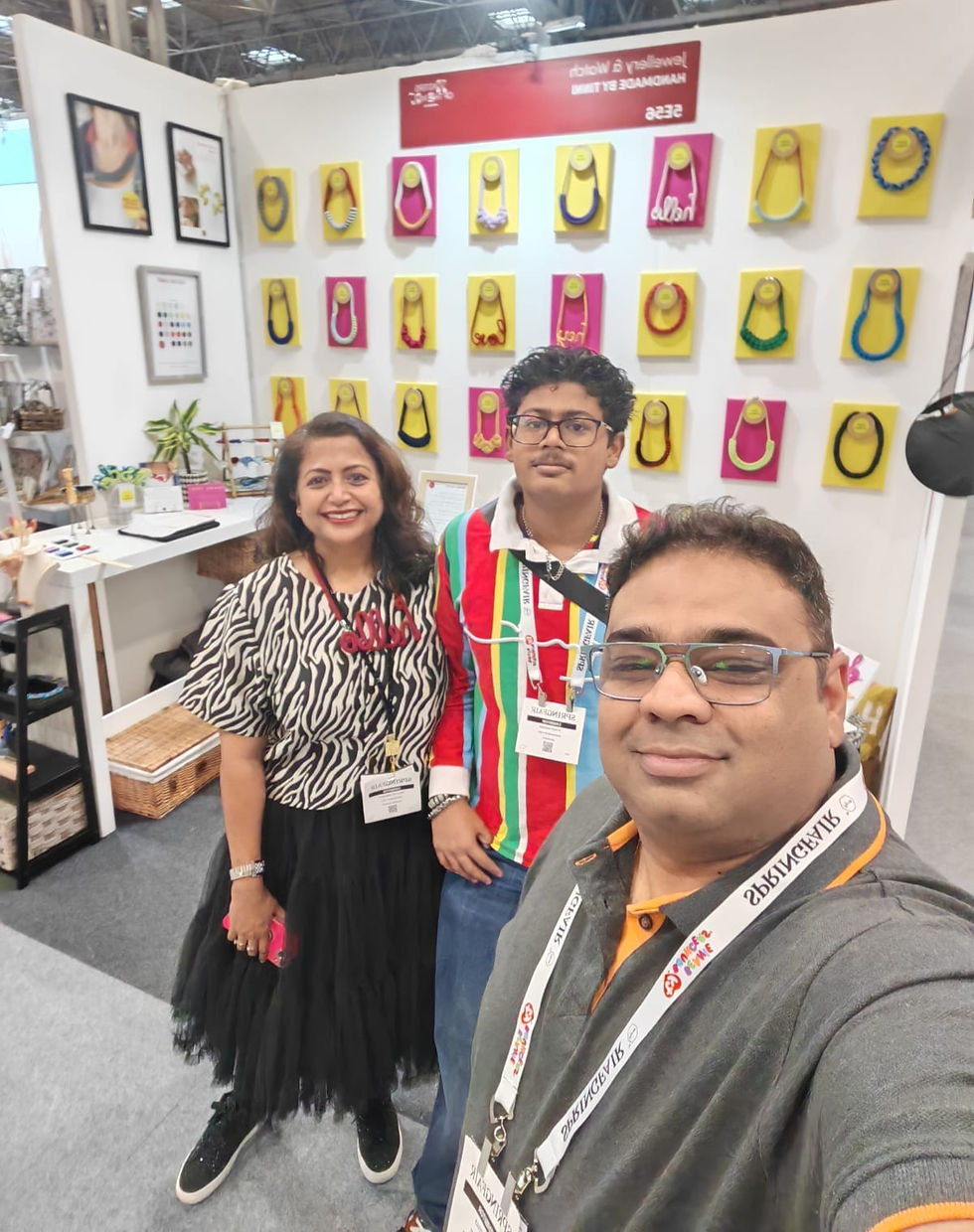
Our little gang was my rock every day at the fair!
One of the nicest parts of doing fairs is how generous people are.
People share things, tips, space, solutions.

19. Don’t wait for buyers — invite them -
Before the fair: who shows up matters
One of the biggest mindset shifts:
What I did (and would 100% do again):
Personally emailed stockists
DM’d warm leads
Reached out manually (not automated)
Because here’s the difference:
Warm visitors → arrive ready to buy
Cold visitors → wander
Pre-fair outreach literally changes the quality of conversations you have.
20. Mirrors were non-negotiable for me -
This wasn’t something I discovered — I already knew it from smaller craft fairs.
If people can try something on, they will.
Even in a B2B setting, that instinct doesn’t disappear.
What I found interesting is how quickly that shifted the conversation from:“this looks nice”to“I can see how this would sit in my shop”
It makes things feel real in a different way.
HIGHLIGHTS:
A few things that worked surprisingly well:
Add your hall + stand number to your bio a week before
Visit fairs before you exhibit (watch buyer behaviour)
Wear your products (you are the best display)
Make your stand photo-friendly (it extends your reach online)
Make tagging easy (for press + visitors)
I was actually featured twice by the Spring Fair social team — purely because the stand translated well visually.
3 Things I Underestimated (and Would Change Next Time)
These aren’t dramatic mistakes — they’re small oversights that had a much bigger impact on the day than I expected.
1. Systems matter more than effort -
I underestimated how much happens in a single day of trading.
You don’t need more energy — you need better systems.
Things like contact capture, scanning badges, or even quick note-taking feel optional before the event. In reality, they shape what you can do afterwards.
Without them, the follow-up phase becomes messy, delayed, or incomplete — and that’s where most of the value is actually recovered.
2. Setup readiness is part of your strategy -
I forgot simple tools like a ladder, and it immediately slowed everything down.
What sounds like a small packing issue actually affects timing, stress levels, and how confidently you start the day.
Now I treat setup lists as part of the brand experience itself — not admin.
If the stand isn’t easy to build, the day starts on the back foot.
3. “I’ll manage it on the day” isn’t a plan -
Trade fairs don’t give you spare capacity.
Anything you assume you’ll figure out in the moment tends to become the exact thing that drains your attention when you need it most.
The smoother the preparation, the more present you can be with buyers — and presence is what actually drives connection and sales.
After the Fair (where the real work happens)
Follow up sooner than feels natural.
You’ll be tired. You’ll want to wait.
But the conversations are still warm — and that’s where the value really is.
But a few days later, they’ve forgotten or they’ve already ordered elsewhere
Even a simple message makes a difference.
✨ Final thought
Trade fairs aren’t just about selling.
They’re about being seen, understood… and remembered.
And once you’ve done one, the next one feels a lot less intimidating.
I’ve turned this into a downloadable one-page guide you can save or print for your next fair.
My love & gratitude:
As a small business owner, I didn’t do this alone.
From painting boards and helping with set-up, to driving, lifting, organising… and then patiently collecting a completely exhausted, slightly zombie version of me at the end of fair— my family were there through all of it.
Trade fairs look like a “one-person brand” from the outside.
In reality, they’re rarely done solo.
Their support made this possible in ways that are hard to fully put into words — practical, emotional, and everything in between. Honestly, they deserve a gold medal (and probably a long nap too).
I couldn’t have done it without them.


Comments